
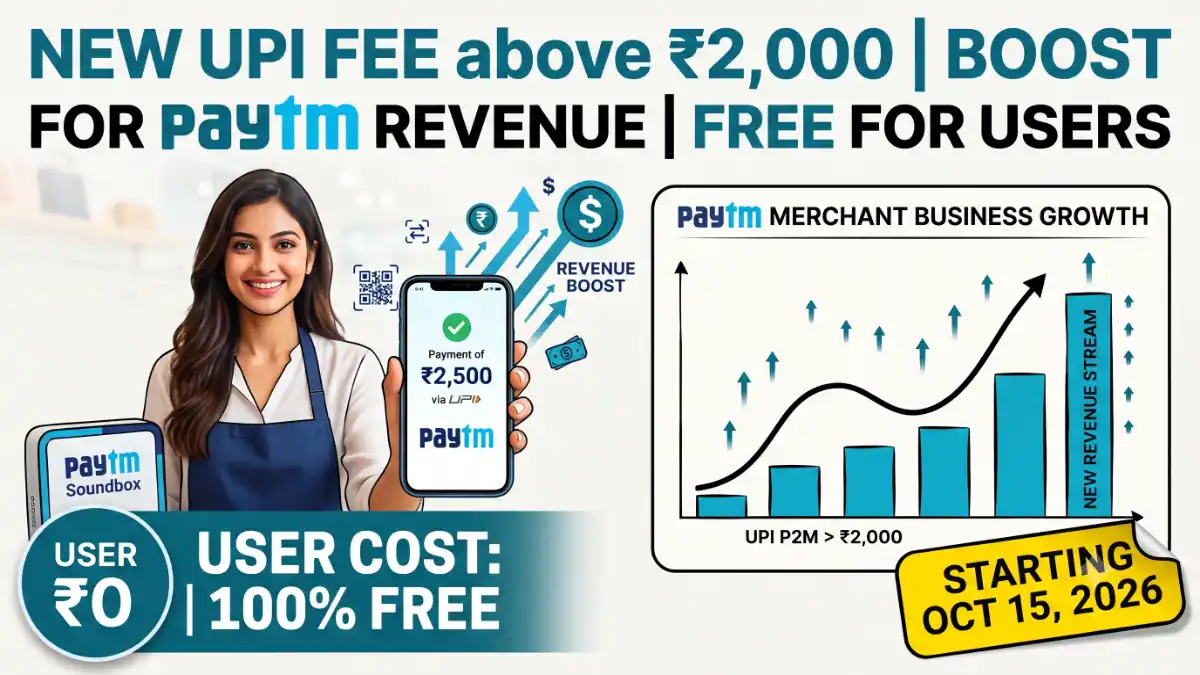

India’s digital payment industry is undergoing a major policy shift. On September 15, 2026, Paytm (One97 Communications Limited) disclosed key regulatory information to the stock exchanges: the National Payments Corporation of India (NPCI) has approved a Merchant Discount Rate (MDR) of up to 0.4% on select Person-to-Merchant (P2M) UPI payments exceeding ₹2,000.
The new directive, set to take effect on October 15, 2026, directly addresses a long-standing challenge facing the Indian fintech sector: how to build a self-sustaining business model based on UPI payment processing.
New UPI MDR Rules Check
The circular (NPCI/UPI/OC-No.237/2026-27) introduces a tiered fee structure to balance fintech profitability with user convenience:
- Transactions Above ₹2,000: An MDR of up to 0.4% applies to eligible merchant checkouts, capped at a maximum of ₹300 for a single transaction of ₹75,000 or more.
- Transactions of ₹2,000 or Less: Continue to avail the benefits of zero MDR and save small businesses, roadside vendors, and local grocery stores from payment processing costs.
- Special Flat Fees: Essential everyday categories such as fuel stations, utilities, school fees, and public transport are covered under special discounts, which also include a flat cap (maximum limit) of ₹5.
- Customer Cost: However, it has been set at zero. Customers will never see any surcharge or fee added to their UPI bills.
What the Update Means for Paytm’s Merchant Business
For several years, payment platforms like Paytm generated revenue primarily from device subscriptions such as for soundboxes and card machines as well as from cross-sold financial products like loans and insurance. Due to the government’s zero-MDR regulations, they did not earn any direct processing fees from the actual volume of UPI transactions processed via their QR codes.
The NPCI circular alters those unit economics:
“This will generate additional revenue from the merchant business for many of the payment transactions that were free earlier,” Paytm stated in its regulatory filing.
Since the MDR applies only to purchases exceeding ₹2,000, Paytm retains its core base of micro-merchants who handle frequent, low-value transactions. New revenue will come from large retail outlets, including consumer electronics stores, clothing brands, and supermarkets.
The 0.4% fee collected is distributed among all parties in the ecosystem, including the acquiring app (such as Paytm), the customer’s issuing bank, and the central switch. Paytm has stated that once the rule comes into effect in mid-October, it will monitor transaction volumes to assess the impact on its quarterly earnings.
Who Pays the New Fee?
| Payment Type | Transaction Value | Fee Rate | Borne By |
| P2P Transfer (Friend-to-friend) | Any amount | ₹0 (Free) | Nobody |
| Small Retail (P2M) | Up to ₹2,000 | ₹0 (Free) | Nobody |
| High-Value Retail (P2M) | Above ₹2,000 | Up to 0.4% (Max ₹300) | The Merchant |
Will Everyday Users Pay More?
No, both the Reserve Bank of India (RBI) and the NPCI have established a rule stating that customers cannot be charged for making payments via UPI.
When you scan a QR code at a store, the amount deducted from your bank account matches the bill amount on your receipt. The 0.4% MDR is essentially a back-end processing cost settled between the merchant’s business account and their payment provider; it works exactly like point-of-sale debit card processing.
Why RBI and NPCI Shifted Away from Zero MDR
Processing billions of UPI transactions every month requires continuous, substantial investment in high-capacity server clusters, cybersecurity protocols, and bank settlement integrations. By levying a nominal fee only on high-value checkout transactions, which account for about 4% to 5% of all daily UPI merchant transactions, regulators have created a commercial model that funds the technical infrastructure without burdening everyday digital use.
Follow us for more Tech News and information.
